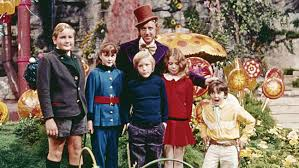
There is one reason I (Cary) wanted to see this movie badly. Candy. Candy? Yes, Candy.
When you are a pre-adolescent ten-year-old, you know few pleasures of life- it is not time yet. All I can recall is I loved candy, and I wanted to be Charlie. I have not read Roald Dahl’s Charlie and the Chocolate Factory, nor am I likely to. Nor have I seen, or plan to see, the later versions of Wonka with Johnny Depp and Timothy Chalamet. Kim did not see it as a child, remembering she didn’t go to movies often. My parents were probably trying to get away from me and possibly spent the two hours at the nearby Elks Club.
This movie immediately reminded me of The Wizard of Oz because it is essentially a musical. Every scene leads to a song. The film begins with a lot of music, and right away, we get the song Candyman. Sir, shut up and give the kid his candy. Does anyone remember Sammy Davis Jr. and his version?
Young Charlie has a paper route, which is common among young men growing up. Along the way, there was a weird man by the gate to the factory, which was odd, something I surely missed a half-century ago. At Willie’s home, his FOUR grandparents were all on one gigantic bed facing one another. Something said they had been bedridden for twenty years, and I immediately winced, wondering how nasty that room may have smelled. Ewwwwwwwwwwwwwwwwwwwwwwwww. Yet, they had a television set.
We join Charlie in school, which is quickly dismissed because Willie Wonka is issuing five golden tickets. This dominates the news internationally and becomes the most important story in the world. Viewers are introduced to four obnoxious, hyper-stereotyped kids who won the first tickets. The first is a ravenous German boy who eats everything in sight. Herman Goering’s grandson? Next is an annoying girl, who Kim says, “She is such a brat!”
She is followed by our third contestant, a young lady from Montana who constantly chews gum. Number four is an Arizonan boy obsessed with westerns. Then the fifth ticket is found, then it is not. Charlie gets it, pursued by another strange man named Oscar Slugworth. When Dahl wrote this story in 1964, he must have been ahead of his time in his pharmaceutical consumption with his imagination. Grandpa Joe can miraculously walk and, of course, dance and sing. He accompanied Charlie to the factory. The family can barely eat, yet he has a nice suit to wear.
Gene Wilder does not appear as Willie until almost halfway through the film. Kim thinks he is creepy, and you know, she is right. Of course, he sings, and we go into the factory where everything is made of candy, with a river of chocolate. The Oompa Loompas appear next, and if you have seen this and know the song, it will be stuck in your consciousness for hours after reading this.
The spoiled kids are loathsome, except for our boy, who is the plot. The parents need a good thrashing for allowing this, but as my mom used to say, “It’s just a movie!” Peripherally, Kim is smiling, watching the kids disappear and Charlie and Gramps floating in this bubble machine.
Finally, all the kids are out, but Charlie is going to be chopped (kudos to Ted Allen), too. In the end, he prevails, and Willie gives him the whole factory. They crash through a glass ceiling and float above the town. Kim observed, “The bad never win, the good do.” Maybe in the movies, my dear…
This fifty-year-old movie is fun. It’s not my style anymore, but I think parents and grandparents could enjoy it with their kids as there is a bit of a moral to the story. I was reminded of his other works, and we do plan to watch Young Frankenstein soon.

 caryheinz.com
Leave a reply to dinacascone Cancel reply