Imagine sitting at a dinner setting with a half dozen people. You query the group and challenge, name a catchphrase or tagline from the Wizard of Oz. Can you make it around the table? Certainly. Twice? Perhaps. I am not listing any here because it is quite likely they are flying around in your head.
By the way, however long this ends up, it could have been book-length. Subsequent ones will not be, I promise.
The Wizard of Oz is a film that Baby Boomers grew up on. It hit the big screen in 1939. November 3, 1956, was the important debut when it became the first Hollywood film to be shown uncut in prime time from coast to coast on television, but The Google can tell you that. Our generation was riveted to the screen one Sunday night every year. The mail carrier brought a small magazine called the TV Guide weekly and that is where we learned what was going to be on.
The technology of color television existed, but all the infrastructure didn’t for some time. Our parents were middle class, but Cary’s family did not get color until the early seventies and Kim’s did soon after. We didn’t get to see the miraculous transformation in color like others right away.
The Review-
On the evening of January 23, 2025, Kim and I sat down to watch it, again. There is no doubt that it has been on our television screen, but we have never consciously sat down to watch it. Before we begin, a few thoughts. Feel free to skip this if you wish.
The film begins visually in ‘sepia-toned’ black and white. The images are more brown than gray. There is A LOT of music, and the credits at the opening stress how the movie is for the “young at heart,” That’s not me, or Kim. We are in our sixties.
Dorothy is riding her bike down a dirt road out on the prairie with Toto. She arrives at their hardscrabble farm and immediately begins whining. OMG, she is unreal. I know the definition of the word brat has changed in the 2020s, but please, Dorothy, go whine to your friends on TikTok. Oh yeah, no electricity, no phone, nothing.
These are really unhappy people. Auntie Em is as irritated with Dorothy as I am. It looks bleak, and we don’t even know what’s coming. No wonder Steinbeck took them all to California in the thirties in The Grapes of Wrath. How’s that working out for your grandkids- Their four seasons are Earthquake, Fire, Mudslide, and Drought.
The three laborers try to accommodate her complaining. Dorothy, think about these guys, thirty-five, and this is the best they can do? Farmhands in Hell Hole, Kansas. Of course, the men show their weaknesses in front of her. She is supposed to be twelve in the movie. Judy Garland was sixteen when the movie was made, and often she acts eight.
Cary found the scene where Dorothy fell off the fence railing. She was walking atop, and he was binging on the show Deadwood at the time. If you have seen it, you know what I am talking about. Soon, Miss Gulch arrives, who does NOT appear in Baum’s book. Toto bit or harassed her cat, so she took her; Toto escaped. When Dorothy runs away, she meets Professor Marvel, and we have now foreshadowed the main characters “over the rainbow.”
Toto takes the Professor’s hot dog, and in his ‘crystal,’ he makes some very general Nostradamus-like assumptions about Dorothy. She runs home and sees all hell breaking loose with the ‘cyclone’ coming. For the record, these form over water- not much of that in Kansas. I (Cary) can do a decent impersonation of Auntie Em calling “Dor-o-thy,” which Kim tolerates. The five adults make it down the storm cellar without this young girl and lock it???? Thinking face emoji…
When a window blows out and knocks Dorothy unconscious, she then sees humorous images outside her home for 1939 technology. Guys rowing a boat inside a tornado? When Miss Gulch appears on her bike, we hear the music and immediately recognize her appearances, like Darth Vader or James Bond. Bam! The House drops, the girl cries, and the door flies open.
At 19:43, we see color. The first film that appeared in technicolor in history dazzles us. The backgrounds look really fake, even back then, but it works. “Toto, I don’t think we’re in Kansas anymore.” A green orb floats in from the distance. It’s Glinda, the good witch. Kim notes, “Her voice is terrible.” The munchkins begin to appear, and they start singing. Everybody is singing; I guess I don’t remember this much of it. One could classify this as a musical.
There must be one hundred of these little people. How much was spent on costumes? Singing, dancing, and a certificate of death. Let me say now the book is much more violent than the film, which makes sense.
Orange smoke! Now, the Wicked Witch of the West pops in. The ruby slippers do not exist in the book. Big drama and Dorothy is soon skipping and singing her way out of Oz. Judy Garland is busting a grove on the yellow brick road. Poor Judy.
I know just enough about the life of this poor woman to tell you that if her mother isn’t in hell- it doesn’t exist. Nuff said you can look that up.
Kim noted how good this was considering the age of the film. I wholeheartedly concur.
Soon, Dorothy meets the Scarecrow. How can he talk? Oh yes, ‘It’s a movie,’ and I bet your parents told you that in childhood. I note that the Yellow Brick Road splits; he points both ways. Hmmm? How does this creature know the correct directions? Did you see a Garmin? After he sings, they take off together, singing, what else?
The actors that played the Scarecrow, Tin Woodman (book), and the Cowardly Lion came from Vaudeville: They were song and dance men. That’s why they were chosen for these roles, but now it’s going to get frightening.
Dorothy and the Scarecrow now walk through a dark forest. This is where L. Frank Baum’s creativity, imagination, and/or perversion take over. When this film came up in my classroom, I often said, “Mr. Oz, would you please submit a urine sample?” He invented some crazy shit, and mean apple trees throwing fruit is out there.
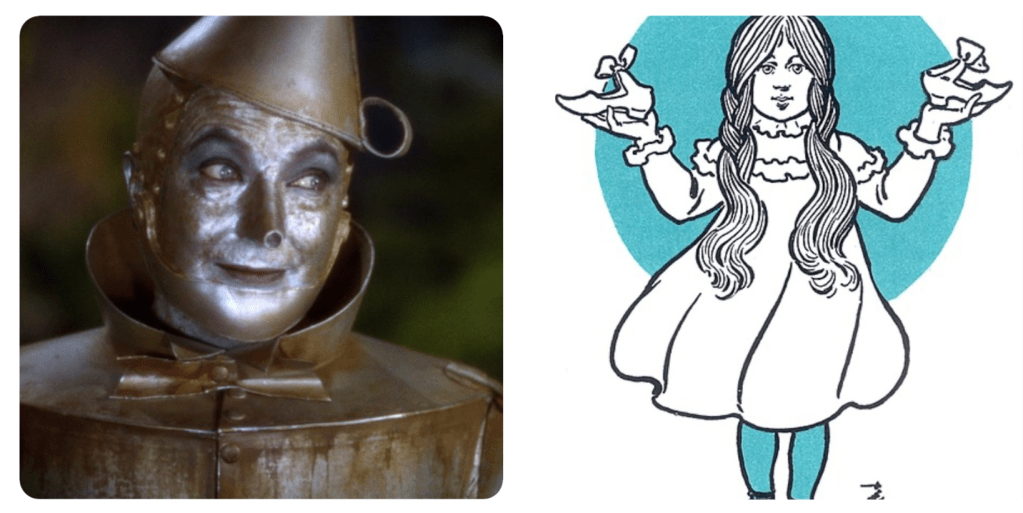
Next up is the Tin Man. For years, if I opened a big can of Foster’s Beer, I would tighten my lips and utter “oil can,” out of the corner of my mouth, as he did. My adult observation is that the Tin Man is a little creepy, and Kim concurs. His expression, eyes, lipstick, just saying. He does his little song and dance, and off the trio goes.
“Put ’em up,” threatens the Coward Lion. He plays with his tail A LOT. He chases Toto, Dorothy slaps him, and he joins the group with more song and dance. These are SEVEN songs already. The Wicked Witch sees them through her crystal ball, and they see the Emerald City. First, they have to traverse poppy fields.
Poppies sound innocuous. They are a flower; they are mentioned in a World War One poem, “In Flanders Field.” Poppy seeds got Elaine Benes in trouble on Seinfeld. Cary’s sarcasm and knowing some very, very bad things coming from this flower is certainly his perspective. The Good Witch makes it snow, and the brainless man helps her save the day.
The Emerald City is their destination, and yes, it’s green! In the book, everyone must wear green goggles. The wicked witch flies in the air and writes words in the sky with her broom, prompting Kim’s laughter. The horse changing color is pretty cool, but it’s not in the book either. They are cleaned up and groomed during (my count) song #9. Then, they get called to see Oz in the great hall.
As a child, that scared the hell out of us. There is the image of his face, the fire, the sounds, the Lion running away and diving into something. They have to get the broomstick of the Wicked Witch. Uh-huh, this Motley Crew is going to find her.
A Cary confession: I have seen this movie repeatedly and am sure I am not alone. For some reason, the part I am least familiar with is the scenes at the witch’s castle. Why? I do not know. Maybe my parents sent me to bed, which is scarier. Second confession: The songs appear while I write and replay the film in my head. It is unstoppable, and you find yourself singing them. Fortunately, no one is near me and can hear my terrible singing.
The book and movie have their most blatant deviations after the Emerald City. They have to find the Witch, who has just one eye in the book. I wonder how Margaret Hamilton would have done what with pre-World War II technology. Oz’s novel has the witch sending wolves, crows, and bees to the ground, which the Woodman and Scarecrow kill. That may not have played well in a kids’ film in this era.
In the book, there is also a group of beings called the “Winkies” and a golden cup placed on Dorothy’s head that grants wishes. The winged monkeys actually help the travelers on paper. The Wizard’s reality is discovered similarly, and the brain, heart, and courage are dispensed in the manner we all know. Oz departs without Dorothy, ending his existence as the ‘Great and Powerful Fraud.’
This relatively short book has another twenty pages before Dorothy returns to Kansas. The Dainty China People and Quadlings are further obstacles that moviegoers would never meet. In this case, the silver shoes bring her home.
Kim said, “It was just a good fantasy, I guess.” She thought it was shorter than she remembered, and there were a lot of Munchkins. The movie still made her happy, and she agreed with the message of never giving up and going for what you want.
Backstory
Most boomer parents introduced Oz to their children as well.
Recall that cable television and VHS tapes did not really hit most homes until the 1980s. We had no choice in our viewing. Did we like this movie or was it just an annual rite of passage like Halloween, Thanksgiving.
The Wonderful Wizard of Oz was a children’s book published by L. Frank Baum in 1900. Mr. Baum is a very interesting man in his own right. He was born wealthy and died wealthy, and to use a term Kim is fond of, his life in between was a shitshow.
Mr. Baum was a dreamer. Most of us grow out of it. He never did. In his case, it paid off, with a lot of hardship on his family. He was born in 1855 near Syracuse, New York. His father made money in a new endeavor called petroleum, pre-Rockefeller. He had an idyllic childhood and a vivid imagination. Frank had no interest in the family business or college. Breeding ‘fancy’ chickens came first, then acting in New York City, where he was considered a ham.
This man just didn’t want to act; he wanted to write, produce, and star. He sought to be Lin-Manuel Miranda over a century earlier. His musical The Maid of Arran did fairly well until he got married, she became pregnant, and reality set in. Having to support a family has quashed the careers of many aspiring artists. Baum then did well as a natural salesman for family products. In 1886, his older brother and father died, and he and his growing family moved west to what would become South Dakota. Watch one episode of Deadwood and decide if you want to bring your family up in that. Another of Kim’s favorite lines is “Hell to the NO!”
On the prairie, he opened a store named Baum’s Bazaar, which could have been called Baum’s Bizarre. Great idea, but much business success is based on three things:” location, location, location. Then the drought came. He tried the newspaper business next, with eight others in a town of three thousand. His American Dream became a nightmare. Native Americans began a fascinating cultural ceremony called the “Ghost Dance,” which scared white people away. Wisely, he gave up and headed for Chicago, where his Bazaar may have worked.
Chicago, two decades after the ‘Great Fire,’ was a booming city. Hope, industry, and optimism beckoned. In 1893, Chicago and America had both good news and bad news. The Pan American Exposition (please read Devil in the White City if you have not.) opened, and that was very good for the Windy City, but the Panic of 1893 was not. He tried his luck as a traveling salesman before automobiles and Holidays Inns. He finally caught a break in a publication with store windows, which used to be a big thing. He had some success writing a children’s book called Mother Goose in Prose. The man who many felt never grew up had his start.
The change occurred in late nineteenth-century America. A group of literate, middle-class children needed entertainment, so he provided it and wrote thirteen sequels.
I (Cary) did not see the 2024 film Wicked. Anyone who knows me gets that. Kim saw it and said, “The bad witch was good in the beginning. They did make her out to be bad at the end. The good witch was sneaky and manipulative. The music was really good, but it was confusing with the bad witch being good.”
Anecdotes
Victor Fleming directed another movie in 1939, Gone with the Wind. It was not too bad a year, Mr. Fleming, not bad at all.
The Tin Man was originally cast by an actor named Buddy Ebsen, who was briefly going to be the Scarecrow. The aluminum dust in the makeup made him ill, and he was out. You may remember him as Jed Clampett in The Beverly Hillbillies
and Barnaby Jones.
Jack Haley Jr., son of the actor playing the Tin Man, married Liza Minelli, Judy Garland’s daughter. That lasted just five years, from 1974-1979.
Poor Judy Garland, born Francis Ethel Gumm, would be married five times in her short (forty-seven years) life. Renee Zellweger played her in a 2019 biopic called Judy, earning her a Best Actress Academy Award. We have watched it, and that film is as sad as Oz is uplifting. Margaret Hamilton, the Wicked Witch, had a five-decade career. Later in life, she appeared in Mister Rogers Neighborhood and Sesame Street. Cora on Maxwell House coffee commercials in the eighties.
 caryheinz.com
Leave a comment