For decades, ‘Likeability:” has been a big factor in the electability of political candidates, particularly at the highest levels. In 2008, the usually articulate Barack Obama commented to one of his opponents “You’re likable enough Hillary” which may have cost him the New Hampshire primary.
Ronald Reagan was certainly a likable, amiable man. After decades as a movie actor and television host, his hundreds of hours in front of the camera honed his skill so well he is known as “The Great Communicator.” He was in front of crowds as well, could tilt his head to the side, softly begin a sentence with “well.” Often, the truth could be stretched with his fabrications of welfare mothers and the like, and we didn’t have these hand-held computers and electronic fact-checkers as we do today.
Reagan, a one-time New Deal Democrat and union (Screen Actors Guild) president had a political transformation to the right in the late fifties. Late in the 1964 presidential election, he gave a speech for Barry Goldwater titled “A Time for Choosing” which instantly put him on the radar for conservatives. Two years later he was elected Governor of California and reelected in 1970. He unsuccessfully challenged President Gerald Ford for the GOP nomination which he narrowly lost. 1980 was the last chance for the sixty-nine-year-old.
Reagan retained his campaign manager John Sears who chose a frontrunner strategy. They chose to nearly ignore the relatively new Iowa caucuses. George Bush followed Jimmy Carter’s 1976 plan putting most of his eggs in the Hawkeye State basket. Bush spent twenty-seven days there, Reagan forty-five hours. Bush won in an upset victory announcing he had ‘Big Mo’ (momentum) heading to New Hampshire.
In the Granite State, Reagan was angry and campaigned harder than he ever had. This helped people forget about his age. After a first debate there (neither Bush nor Reagan stood out), a second debate was scheduled for the city of Nashua. There was discussion about whether this would be just Reagan vs. Bush or the entire field. After much negotiating, Reagan ended up paying for the debate, leaving him in charge.
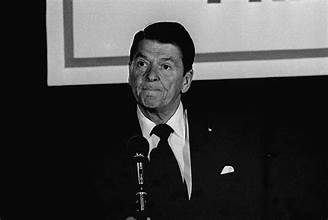
The start of the debate was farcical, almost out of a show like Veep. Bush wanted one on one and Reagan wanted everybody. Jon Breen, the moderator, would not allow the other four candidates John Anderson, Howard Baker, Phil Crane, and Bob Dole to come on stage. When Breen began by laying out the ground rules, Reagan interrupted, and Breen instructed a technician “Would the sound man please turn Mr. Reagan’s mic off for a moment?”
We all have a temper of some sort, and this set Reagan off “I am paying for this microphone Mr. Green!” Reagan mixed up the man’s name in his anger, but the audience cheered wildly. George Bush sat impassively, an image that did not help him with New Hampshire voters, or Reagan. The ‘Gipper’ would defeat Bush 50-22 when voters went to the polls, sinking ‘Big Mo’ like the Bismarck. William Casey replaced Sears atop the campaign.
Bush would finish second to Reagan in delegates. At the Detroit convention, Reagan and former President Ford considered Ford joining the ticket in a quasi ‘co-presidency,’ which wouldn’t work out in reality. Reagan then offered the VP slot to Bush, and they would go on and win landslides in both 1980 and 1984. Bush would be elected president in his own right in 1988.
 caryheinz.com
Leave a comment