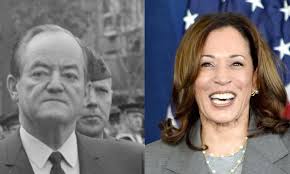
Since Joe Biden left the 2024 presidential race on July 21st, Donald Trump has frequently mentioned his name and noted that Vice President (and Democratic nominee) Kamala Harris shouldn’t have the party’s nomination because she received no votes. One could argue that she did as the presumptive running mate (no sitting VP has been removed from a party’s ticket since 1944). Still, it doesn’t matter because the Democratic Party seamlessly switched to her and voted virtually before the Democratic National Convention in Chicago. From my understanding, the party could nominate any qualified citizen excluding Bill Clinton and Barack Obama due to the Twenty-Second Amendment.
The Democrats nominated a candidate in 1968 with very few primary votes and was coincidentally a sitting vice-president. The Rolling Stones song Under My Thumb was about a man and a woman. It could have been about the relationship between Lyndon Johnson and Hubert Humphrey. President Johnson played games with Humphrey in the summer of 1964 regarding the vice presidency, which he ultimately offered.
Vietnam overshadowed LBJ’s domestic accomplishments in his Great Society. In 1968, the war in Southeast Asia was not going well, and Minnesota Senator Eugene McCarthy challenged Johnson, and after a surprising finish in the New Hampshire. New York Senator Robert Kennedy joined the race. On March 31. Johnson shocked the nation by withdrawing, much like Biden did, albeit four months later.
LBJ was a large, intimidating alpha male who was fond of invading people’s personal space which was called the “Johnson Treatment.” He may have been off the 1968 ballot, but he was still POTUS and head of the Democratic Party. Humphrey would have a hard time leaving Johnson’s shadow and becoming his own man.
Humphrey was now free to run in his own right but had to postpone his announcement after the assassination of Dr. Martin Luther King Jr on April 4th. He faced many challenges with two senators already in the race, and many contributors and strategists were already locked up. Additionally, it was too late to get on the ballots in many states so Humphrey had to take the old school route to the nomination. He received a negligible number of primary votes. In early June Kennedy was assassinated and this tumultuous year became worse.
He used ‘favorite son’ surrogates to win delegates for him and solicited support from party leaders. These included Indiana Governor Roger Branigin, Florida Senator George Smathers of Florida, and Senator Stephen Young of Ohio. Frank Sinatra supported Humphrey, who was not the equivalent of Taylor Smith today but ‘Old Blue Eyes’ was a very popular entertainer most if his life.
His early campaign staff was headed by Oklahoma Senator Fred Harris, (no relation to the current VP) who sought the Democratic nomination in 1972 and 76) and Minnesota Senator Walter Mondale who was elected vice-president in 1976 and was the unsuccessful Democratic nominee in 1984. After the controversial Democratic National Convention in Chicago, former Kennedy and Johnson strategist and future NBA Commissioner Larry O’Brien took over the campaign.
Alabama Governor George Wallace was the “x” factor in 1968 running as an independent. Wallace stole votes from Humphrey in Northern states, and Nixon in Southern states, and is the last third-party candidate to win an electoral vote, forty-six in all in five states from Dixie.
Hubert Humphrey split with Johnson on Vietnam in a September 30th speech in Salt Lake City Utah and the race with Republican nominee Richard Nixon tightened. Although Nixon won the Electoral College handily, the popular vote was very close. Nixon prevailed by 0.7%, about a half million votes out of over seventy million.
Hubert didn’t make it, but we’ll see how Kamala does.

 caryheinz.com
Leave a comment