When a young man fired shots at former President Donald Trump at a campaign rally in Butler, Pennsylvania, history geeks like me were reminded of a similar event.
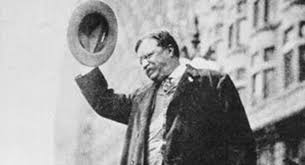
On October 14, 1912, in Milwaukee, Wisconsin (coincidentally where the Republican convention will take place the next week), a former president from New York was trying to return to the White House after a four-year absence. Roosevelt was entering his car at the Gilpatrick Hotel when a thirty-six-year-old unemployed bartender named John Schrank shot Roosevelt in the chest.
The shot came from near point-blank range and TR’s stenographer prevented the gunman from attempting a second shot. Fortunately for the former president, a thick winter coat, steel eyeglass case, and fifty-page manuscript in his jacket pocket significantly slowed the bullet’s path.
Roosevelt gave his speech anyway against the advice of his doctor. Having served in combat and not spitting blood, he knew the bullet had not pierced his lungs. The often-dramatic Roosevelt (whose acerbic daughter once quipped “My father always wanted to be the corpse at every funeral, the bride at every wedding, and the baby at every christening” quieted his audience, informing them of the shooting and displaying his blood-stained shirt. He famously asserted, “It takes more than that to kill a bull moose” (the animal being the nickname of his political party.) Remarkably, he then spoke for ninety minutes.
Finally, he finished, and the doctor located a wound under the right nipple that broke his fourth rib. Doctors decided it was safer to leave the bullet where it was, an approach slain President James Garfield would have preferred in treatment that has been described as “killed by his doctor.”
Even though three presidents had been assassinated in the previous forty-seven years, security was still remarkably lax. Since TR was an ex-president, he wouldn’t have had the Secret Service to protect him. They did not protect former presidents or candidates until the sixties.
Theodore Roosevelt and Donald Trump do have a few other things in common. Both were born in New York City to financially prosperous families. Both were attention starved bombastic public speakers.
Both men took drastically different routes to the presidency. TR entered the New York State Assembly at the age of twenty-three. Trump was sixty-nine before he first ran for office, the presidency.
Teddy Roosevelt suffered one of the worst days imaginable when on February 14, 1884, his wife and mother died on the same day. He overcame his grief as a western cowboy in the Dakotas and returned to New York politics. He became a national hero in the Spanish-American War. In 1900, President William McKinley made him his vice-president and when he died from an assassin’s bullet on September 14, 1901, TR became the youngest American President at the age of forty-two. Conversely, Trump was the oldest man at the time to become president.
TR loved the action of the office in what he called the ‘arena,’ and was only fifty when his seven and a half years in the White House (a term he coined for the mansion) ended. He was restless for four years and increasingly criticized his successor and friend William Howard Taft. Unable to sit still, he challenged Taft for the 1912 Republican nomination unsuccessfully. Undeterred, he ran as a third-party candidate in the Progressive or ‘Bull Moose’ party. This is why Roosevelt was campaigning in Milwaukee.
Taft sent TR a sympathetic telegram, and Democratic candidate Woodrow Wilson offered to suspend his campaign which Roosevelt refused. Two weeks after the shooting, TR gave a forty-two-minute speech at Madison Square Garden in front of sixteen thousand people. His entry into the race split the Republican Party and allowed Wilson to be only the third Democrat elected in fifty-six years.
I emphatically oppose violence of any kind.
 caryheinz.com
Leave a comment